Supermarket tastings have long been one of the most effective tools for product promotion. The buyer gets the opportunity to immediately try the product, compare it with its analogues and make a purchase decision right on the sales floor. For brands, this format helps to increase awareness and bring a new product to the market faster.
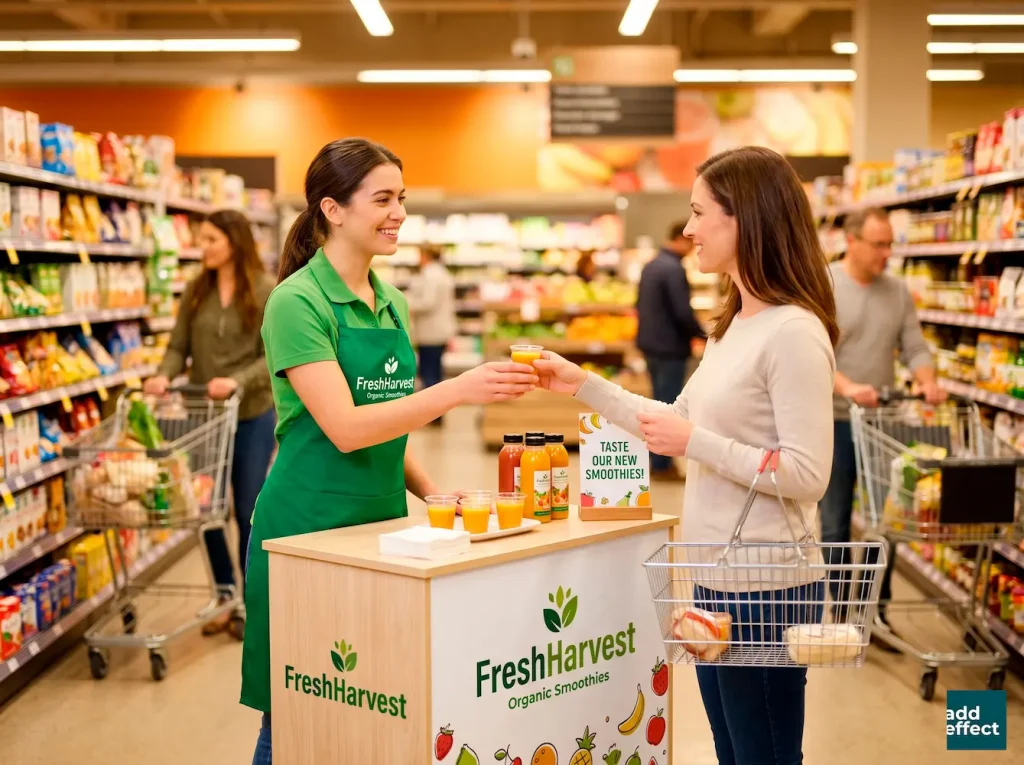
However, a successful tasting requires careful preparation. It’s not enough to just install a promo card and distribute samples. It is important to think over the action scenario, select staff and properly organize interaction with supermarket visitors.
What tasks does product tasting solve
Promotions with free sample giveaways help brands interact directly with their audience. This format is especially effective for food, beverages, and novelties that the customer wants to evaluate before buying. Tastings are most often launched for the following purposes:
- Increase brand awareness;
- Stimulating impulse purchases;
- New product presentations;
- Increase sales at a specific outlet;
- Collecting customer feedback.
During the tasting, a person makes a decision faster, because they can immediately assess the taste, quality, or features of the product. An additional role is played by live communication with the promoter, who answers questions and talks about the advantages of the product.
At the same time, the effectiveness of the campaign directly depends on the venue. Even a high-quality product can be ignored if the counter is located in a low-traffic area or is poorly designed visually.
Step-by-step tasting launch plan
The organization of the tasting in the supermarket includes several stages. Each of them affects the final result and helps to avoid problems during the campaign. The preparation usually follows the following plan:
- Defining the objectives of the advertising campaign and selecting products for tasting.
- Coordination of the terms of the promotion with the supermarket administration.
- Selection of promoters and staff training on product features.
- Preparation of promotional materials, POS materials and branded design.
- Organization of logistics, delivery of products and supplies.
- Conducting an action and monitoring the work of the staff on the site.
Special attention should be paid to the training of promoters. They form the first impression of a brand and help to engage customers in communication. Good staff does not just offer to try the product, but knows how to maintain a dialogue and competently present the product.
It is also important to calculate the number of samples and supplies in advance. A shortage of products during the campaign can negatively affect the perception of the brand and reduce the effectiveness of the entire campaign.
What influences the result of the promotion
Even a small tasting requires a comprehensive approach. The bottom line is influenced not only by the product itself, but also by many organizational details. When planning an action, it is worth considering several factors:
- The time of the event and the hours of maximum attendance;
- The location of the promo stand inside the supermarket;
- The appearance of the branded area;
- The quality of the promoters’ work;
- Availability of additional promotional materials.
Visual design is of great importance. The bright promotional logo, branded uniforms and neat product layout help to attract the attention of visitors even in a busy sales area.
In addition, tastings work well in combination with additional promotion mechanics. For example, discounts, gifts for purchases, or temporary promotional offers.
A well-organized tasting helps the brand to increase sales and establish direct contact with customers. This format of promotion is especially effective in supermarkets with high attendance, where the purchase decision is often made spontaneously.
At the Add Effect agency, you can order the organization of tastings, promoter services, design of promo zones, production of POS materials and BTL promotions in Tashkent to launch advertising campaigns of any scale.